


NewsGate Press Network
Chanakya Defence Dialogue conducted by Indian Army in collaboration with the Centre for Land Warfare Studies concluded on Friday the 28th of November 2025 in the National Capital.
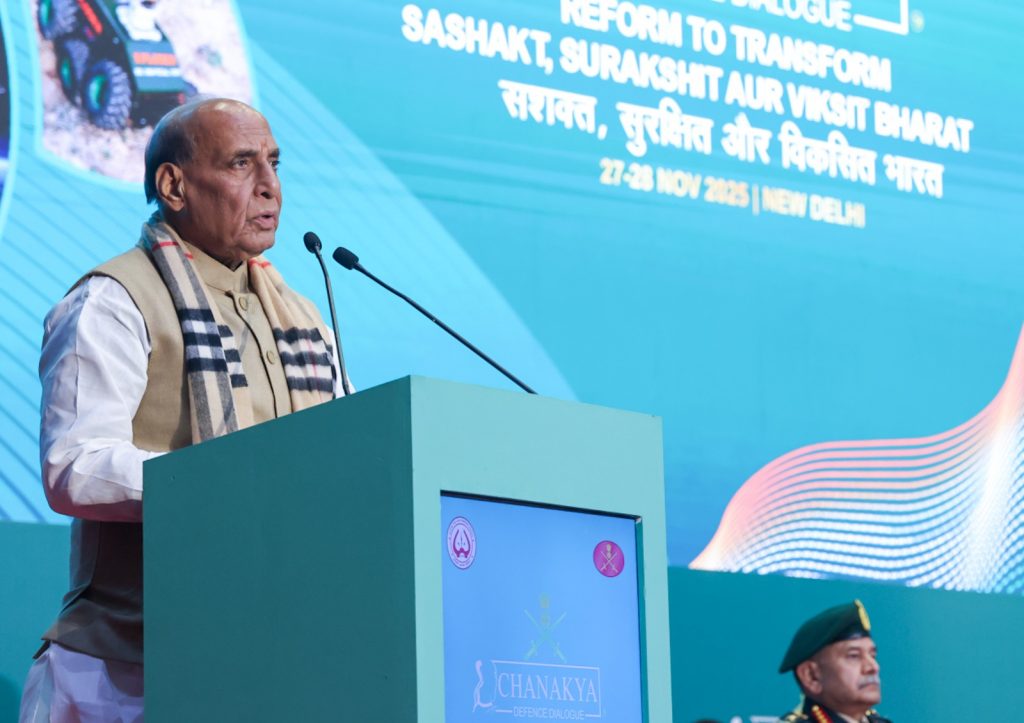
The two-day Dialogue was conducted at the Manekshaw Centre, Delhi Cantt where the Defence Minister Rajnath Singh was present along with Gen Upendra Dwivedi the Chief of Army Staff.
The Chanakya Dialogue reflects the national aspiration for a Sashakt, Surakshit aur Viksit Bharat, bringing focus to India’s emerging security challenges, defence reforms and technological transformations amid an increasingly complex global order.
Rajnath Singh unveiled key Green and Digitisation initiatives and delivered a special address on Defence Reforms for a Sashakt, Surakshit aur Viksit Bharat.
He emphasised that the Chanakya Defence Dialogue is a vital forum where the Indian Army’s operational experience merges with strategic thinking to shape future-ready policies.
He noted that the reforms are a strategic necessity amid shifting global power centres, blurred boundaries between peace and conflict and expanding domains of warfare including cyber, space, information and cognitive influence.
He underlined India’s growing global role, driven by economic strength, technological capability and principled foreign policy.
Reforms, resilience and modernisation, he said, must strengthen defence, economy and society, with the armed forces as the strongest pillar of national security and stability.
Stressing the government’s focus on capability enhancement, infrastructure, technology and welfare of soldiers and veterans, he added that a strong, secure and developed India contributes to global stability, ethical use of emerging technologies and humanitarian values.
He commended the Dialogue’s rich deliberations and affirmed that such platforms deepen strategic foresight and guide India’s journey towards a confident and future-ready Bharat.
Ambassador DB Venkatesh Verma, Member of the National Security Advisory Board, delivered a special address on Resilient National Security @2047.
He stressed that strategic autonomy is meaningful only when India has the will and capability to think, act and fight independently, without allowing external engagements to turn into vulnerabilities.
He emphasised the need for an operationally sound military doctrine that can be executed without external interference, supported by a resilient defence-industrial base, secure technology choices and reduced economic dependencies.
Verma noted that strategic autonomy also depends on societal factors such as national self-confidence, willingness to invest in defence and the ability to produce skilled manpower for modern warfare.
Highlighting the importance of balancing productivity, security and welfare power, he called for faster reforms, higher defence spending, stronger R&D and integrated joint military structures.
He concluded that India’s long-term resilience and rise as a major power will depend on sustaining higher economic growth and ensuring that dependencies do not erode autonomy.
Ambassador Pankaj Saran, Former Deputy NSA delivered a thematic address on Redefining Strategies in Conventional Wars through Technology, emphasising doctrinal shifts and technology-driven readiness.
He highlighted the growing centrality of technology in national security, noting that its role in conventional warfare is now unquestionable and historically inseparable from the evolution of conflict.
Drawing on his experience as Deputy NSA and Ambassador, he reflected on how India’s strategic institutions have increasingly recognised technology as a core pillar of security, citing the 2018 reforms in the National Security Council Secretariat that created a dedicated technology division as a decisive shift in mindset.
He emphasised that India must build on this foundation, learn from past decades and adopt new approaches.
Acknowledging the professionalism of the armed forces and the rising stature of the Chanakya Defence Dialogue, he underlined the need for continued integration of technology, institutional reform and forward-looking thinking to strengthen India’s preparedness for future challenges.
The Friday’s sessions dwelt upon Battlefield Equalisers, where global experts discussed disruptive technologies such as AI, autonomous systems, hypersonics and cyber capability, highlighting how these are reshaping the character of warfare.
The sessions also examined the transformation required for India’s forces to become integrated, agile and modern.
Distinguished military leaders and experts spoke on jointness, adaptive structures, island security perspectives and the growing role of information and cognitive security in modern conflict.
Lt Gen Pushpendra Pal Singh, Vice Chief of the Army Staff, delivered the Closing Address of the Dialogue, emphasising that India’s security environment demands forces that are agile, technologically empowered and operationally integrated.
He noted that the insights generated during the two days, ranging from emerging technologies and battlefield equalisation to jointness, innovation and defence reforms, would serve as actionable inputs for the Army’s transformation roadmap.
Underscoring the importance of self-reliance, future-ready structures and mission-driven capability development, he reiterated the Indian Army’s commitment to accelerating reform and strengthening India’s preparedness across all domains of warfare.
Across its two days, the Chanakya Defence Dialogue 2025 provided an authoritative platform for shaping India’s future defence posture.
Comments are closed for this post.