


NewsGate Press Network
Launched in the aftermath of devastating cyclone Ditwah in Sri Lanka, Operation Sagar Bandhu stands as a testament to the deep emotional bonds between the peoples – and the trusted partnership between the Governments – of India and Sri Lanka.
In a statement released by the Ministry of External Affairs (MEA) on Tuesday the 9th of December 2025, India remains fully committed to continue working with the Sri Lankan authorities in the ongoing Operation Sagar Bandhu, to ensure early recovery, rehabilitation and reconstruction.
Operation Sagar Bandhu was launched on 28 November 2025 as the First Responder in the immediate after the cyclone to provide urgent Humanitarian Assistance & Disaster Relief (HADR) support to Sri Lanka.
Working in close coordination with Sri Lankan authorities, India has been delivering life-saving assistance, essential relief supplies and humanitarian support, and critical early-recovery capabilities across Sri Lanka, including in areas that were badly impacted and had been rendered inaccessible.
This has been done by swiftly dispatching emergency relief material by air and sea; rapidly deploying several specialized search and rescue units, medical and engineering equipment and teams including BHISHM Cubes and Bailey bridge systems; and setting up an Indian Army Field Hospital.
As Op Sagar Bandhu is on-going, some highlights of the HADR work carried out till date, are as follows:
Delivering Relief
Within the first three days of Cyclone Ditwah, 53 tons of emergency relief material was delivered; and several specialised search and rescue units and medical teams were deployed.On 28 November 2025, 9.5 tons of emergency dry rations from Indian Navy Ship (INS) Vikrant and INS Udayagiri were handed over to Sri Lanka authorities in Colombo.On 29 November and 30 November 2025, further 31.5 tons of relief material was sent by three Indian Air Force (IAF) aircrafts – two C130J and one IL76 – which included tents, tarpaulins, blankets, hygiene kits etc; as well as high-priority medical HADR supplies, including two BHISHM Modular Trauma Cubes, over 4 tons of essential medicines and medical items, an Aarogya Maitri team of trauma specialists and emergency physicians, and two specialized Urban Search and Rescue (USAR) teams of India’s elite National Disaster Response Force (NDRF).
On 01 December 2025, additional 12 tonnes of essential relief supplies arrived in Trincomalee aboard INS Sukanya
- On 02 December 2025, an IAF C-17 Globemaster airlifted a modular Indian Army field hospital – including ambulances, trauma care units, operation theatres, and 73 personnel – to support urgent medical needs. 500 mobile water purification units were also despatched.
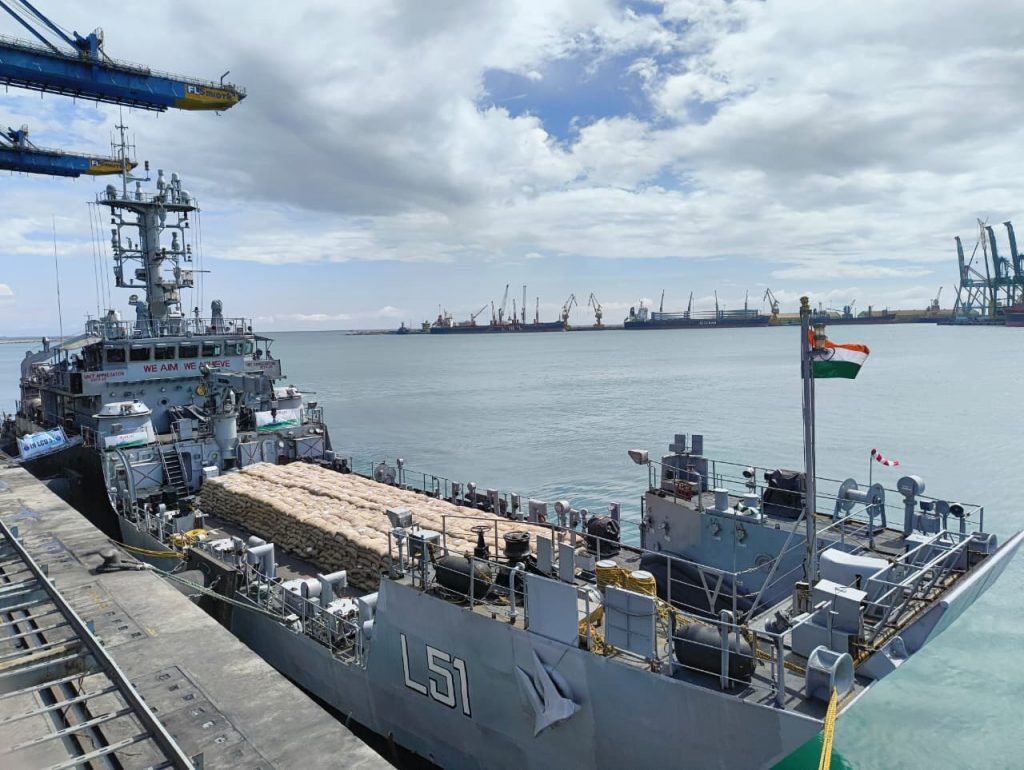
- On 06 December 2025, Government of India facilitated the sealift by Indian Navy of a total of 997 tons of dry rations and other relief material from the State Government of Tamil Nadu to Sri Lanka.
Three Indian Navy Landing Craft Utility ships, INS L51, INS L54, and INS L57, carried 352 tons of relief material from Tuticorin, which arrived in Colombo on 07 December 2025.
INS Gharial carried 645 tons of relief material from Chennai, which arrived in Trincomalee on 08 December 2025.
Saving Lives
- India was the first country to deploy trained disaster responders in Sri Lanka, ensuring that specialised teams reached within the first 24 hours of Cyclone Ditwah, when search and rescue efforts were most needed.
Till date, over 450 persons have been rescued and assisted.
- On early morning of 29 November 2025, an IAF IL-76 aircraft brought two specialized teams of India’s elite National Disaster Response Force (NDRF) to Colombo.
The NDRF teams, comprising 80 personnel and a K9 search and rescue unit, worked in coordination with Sri Lankan authorities, and were deployed to some of the worst cyclone-affected areas, including Badulla, Kochchikade, Puttalam, Colombo, and Gampaha. NDRF’s operations involved navigating submerged neighbourhoods, reaching stranded households, assisting those trapped inside damaged structures, recovering mortal remains of the deceased, distributing aid, and providing immediate paramedic attention where needed.
The teams responded to every call for assistance despite hazardous water conditions, damaged access routes, and unstable terrain.
- Two Chetak helicopters from INS Vikrant were deployed in the first two days of Op Sagar Bandhu.
This was followed by over a week of two IAF Mi-17 V5 helicopters being deployed in sustained daily operations.
Both sets of helicopters worked with Sri Lankan Air Force personnel for swift rescue operations, helping pregnant women, infants, persons with disabilities, and other vulnerable community members; airlifting critically injured persons; transporting Sri Lankan Army personnel to landslide affected areas; and distributing relief material to remote and inaccessible areas.
The IAF’s Mi-17 HADR operations in Sri Lanka are continuing.
- The Aarogya Maitri team operated a medical unit for several days by deploying the BHISHM Cubes to provide urgently needed assistance, as well as undertook on-site training of Sri Lankan Air Force medical officers in Katunayake, enabling the further deployment of the BHISHM Cubes to other affected areas.
- The Indian Army Field Hospital, which has been set up at Mahiyanganaya in Badulla district, has treated 3388 persons till 08 December 2025, including performing surgeries.
The Field Hospital continues to remain deployed.
Restoring Connectivity
- Between 03 December and 09 December 2025, four modular Bailey Bridge systems along with specialised teams of Indian Army Engineers, have been airlifted by four IAF C-17 Globemaster aircraft for deployment in Sri Lanka.
- These rapidly installable bridge structures will enable restoration of critical connectivity links, which would improve access for provision of relief to landslide and flood affected areas.
Comments are closed for this post.