


NewsGate Press Network
The principal opposition party, the Congress has castigated the India-US Trade Deal stating that it is anti-farmer.
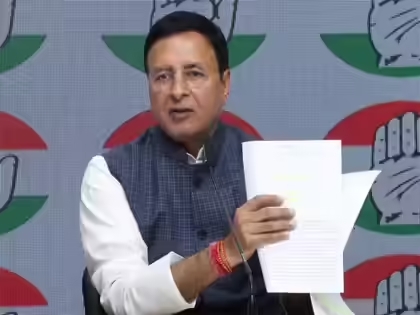
While speaking to the media on Monday the 16th of February 2026, Congress General Secretary and MP Randeep Singh Surjewala termed the Indo-US Trade Deal a “one-sided and unequal agreement” that undermines India’s sovereignty and domestic economic priorities.
According to Surjewala the Indio-US trade deal is “one-sided and unequal agreement” that undermines India’s sovereignty and domestic economic priorities.
The opposition party says the agreement compromises farmers’ livelihoods, India’s energy security, digital sovereignty and economic self-reliance, asserting that “national interest cannot be mortgaged” under the guise of a trade pact.
Surjewala said trade agreements must be based on parity and mutual public interest, and cannot become instruments that compromise sovereignty or the livelihoods of millions.
He said that 1.44 billion Indians would not accept any arrangement that weakens the country’s self-reliance and questioned the Modi govt’s move to open India’s agricultural markets to duty-free imports of US food and farm products.
He said the proposed import of products such as Dried Distillers’ Grain (DDG) or processed maize, sorghum, soybean oil and cotton would adversely impact domestic producers.
India, the Congress leader compared the production of maize which is approximately 43 million metric tonnes of India versus 425 million metric tonnes of the United Staes.
Stating that the US needs a big market like India to sell such a huge quantity of maize, he asked how Indian farmers would compete if duty-free imports are allowed.
Similarly, he cited India’s annual sorghum output of 5.2 million metric tonnes against 8.7 million metric tonnes in the US, and soybean production of 15.3 million tonnes against 120 million tonnes in the US, warning that tariff-free imports could depress domestic prices and adversely affect farmers.
On cotton, Surjewala referred to a recent US-Bangladesh trade arrangement and statements by Union Commerce Minister Piyush Goyal, saying that India may allow duty-free US cotton imports to secure benefits on export of textiles, which he said would hurt cotton-growing states such as Maharashtra, Gujarat, Madhya Pradesh, Rajasthan, Haryana, Punjab, Andhra Pradesh, Karnataka and Telangana.
He remarked that Bangladesh, which currently buys 50% of its cotton requirement from India, may now stop those imports and source cotton from the US.
Calling it a double whammy for Indian cotton farmers, he said the Modi government has already started importing American cotton.
In 2024-25, India imported cotton worth ₹3,428 crore from the US, causing domestic cotton prices to crash ₹1,000 per quintal below the MSP.
He also asked what would happen to India’s textile mills and garment manufacturers in such a scenario.
Surjewala also warned that the trade deal could severely impact India’s fruit and nut growers if duty-free imports from the US are permitted, saying producers of apple, pear, orange, banana, strawberry and guava, as well as almond, walnut, pistachio and peanut farmers, would face price pressure and loss of market share.
He said lakhs of growers in states such as Himachal Pradesh, Uttarakhand, Jammu and Kashmir and the Northeastern region, along with farmers in Uttar Pradesh, Madhya Pradesh, Maharashtra, Karnataka, Kerala, Telangana, Odisha and Andhra Pradesh, could be adversely affected if American produce floods the domestic market.
The Congress leader, who is himself a farmer also raised concerns about the possibility of genetically modified (GM) agricultural imports, expressing apprehension that the import of processed maize, jowar, soybean and other products from the US would harm India’s biodiversity and seed purity.
He questioned whether the Modi government has quietly allowed GM crop imports through the back door.
Surjewala said that the clause on removing ‘non-tariff barriers’ in the trade deal implies removal of subsidies for Indian farmers.
He said that while the US provides substantial annual farm subsidies, Indian farmers receive limited direct support, and any further reduction in protective measures would be detrimental.
Referring to energy security concerns, the Congress MP said that the trade understanding includes commitments affecting India’s crude oil imports.
Pointing to statements made by US officials following the agreement, which said that India has committed to restricting crude oil purchases from Russia, Surjewala also referred to earlier American curbs on Iranian oil imports.
India is the world’s third-largest crude oil importer and has sourced a significant portion of its oil from Russia in recent years, he said, adding that shifting to US supplies without price assurances could adversely impact energy costs.
He emphasised that such conditions amount to a direct compromise of India’s sovereign decision-making in energy procurement.
Surjewala also criticised the provision in the deal requiring India to purchase $100 billion worth of American goods annually for five years, amounting to a total of $500 billion, terming it inconsistent with the earlier joint statement that spoke of expanding “mutual trade” to that amount.
He noted that in 2024, India exported $81 billion worth of goods to the US and imported $43 billion worth of goods, resulting in a trade surplus of $38 billion in India’s favour.
“Is this agreement based on equality or coercion?” he asked, adding that the government must clarify whether it represents a “strong government” or a “compromised government”.
The Congress leader demanded transparency from the Centre and called for a detailed disclosure of all terms of the trade agreement, asserting that any arrangement undermining farmers, energy security, or national sovereignty would be unacceptable.
Comments are closed for this post.