


NewsGate Press Network
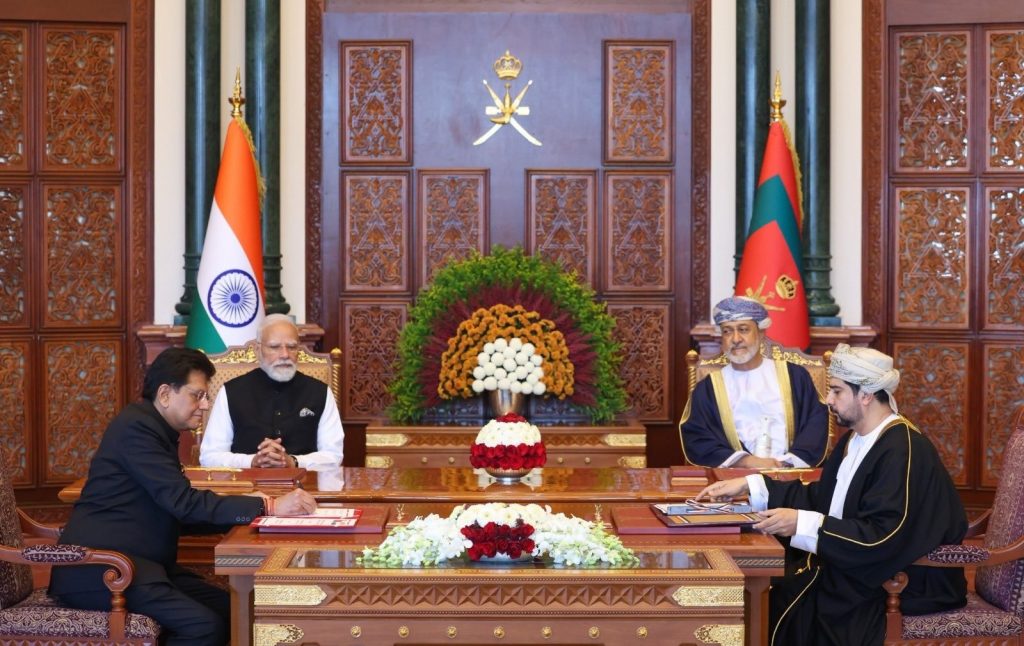
India and Oman has signed the free trade agreement as Prime Minister Narendra Modi held talks with the ruler of Sultan Haitham bin Tarik.
The signing ceremony took place on Thursday the 18th of December 2025 in present of Modi just before he emplaned for Delhi.
Earlier when the Prime Minister who arrived in Oman on Wednesday on the last leg of his three-nation tour, was welcomed by Sultan Haitham at Al Baraka Palace in Muscat before the bilateral meeting.
During the meeting, both leaders explored ways to further add greater depth to the India-Oman Strategic Partnership, Ministry of External Affairs Spokesperson Randhir Jaiswal said.
“Both leaders exchanged views on a broad range of topics, including defence, security, trade & investment, energy, agriculture, technology, new and emerging areas, culture and people-to-people ties among others. They also discussed issues of regional and global interest,” Jaiswal said.
Mohammed Al Yousef – is expected to enhance market access, promote investments, and strengthen cooperation across key sectors.
It will support trade diversification and supply chain resilience at a time of global economic realignment.
This is Oman’s second FTA with an individual country and the first FTA they have done in about 20 years.
Randhir Jaiswal the Official Spokesperson of the Ministry of External Affairs (MEA) said the signing of the FTA was a “new chapter” in India-Oman strategic partnership, marking a significant milestone in their bilateral economic relations.
He said the agreement will increase the trade between India and Oman, boost investment, catalyse economic diversification, unlock opportunities in all major sectors of the economy, enhance economic growth and generate employment.
“For people, CEPA means more jobs, better market access for businesses, stronger supply chains and greater economic opportunities on both sides,” he added.
In the last few years, India has signed many free trade agreements (FTAs), which are reaping rewards for farmers, traders and exporters. Some of them include the UK (2025), EFTA (2024), Australia (2022), the UAE (2022) and Mauritius (2021).
Comments are closed for this post.