


NewsGate Press Network
Prime Minister Narendra Modi on Monday the 16th of February 2026 inaugurated the world’s largest artificial intelligence summit and the India AI Impact Expo at Bharat Mandapam in the National Capital New Delhi.
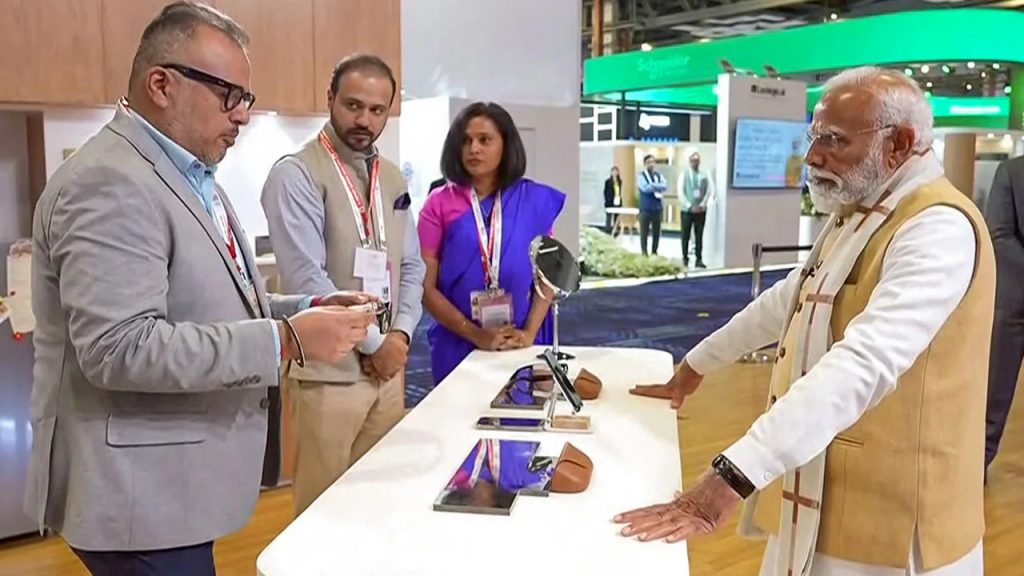
Modi took time to visit many stalls at the Expo personally inquiring at the fast changing facets of technology of the artificial intelligence.
The India AI Impact Expo 2026 is being held alongside with the AI Summit and is scheduled to conclude on 20th of February 2026.
The Expo will serve as a national demonstration of AI in action, where policy meets practice, innovation meets scale, and technology meets the everyday citizen.
Spread across 10 arenas covering more than 70 thousand square metres, the Expo has brought together global technology firms, startups, academia and research institutions, Union Ministries, State Governments, and international partners.
The Expo also features 13 country pavilions, showcasing international collaboration in the AI ecosystem.
These include pavilions from Australia, Japan, Russia, United Kingdom, France, Germany, Italy, Netherlands, Switzerland, Serbia, Estonia, Tajikistan and Africa.
The Expo is hosting over 300 curated exhibition pavilions and live demonstrations, structured across three thematic chakras – People, Planet and Progress.
The Expo is featuring over 600 high-potential startups, many of them building globally relevant and population-scale solutions. These startups will demonstrate working solutions that are already deployed in real-world settings.
The enthusiasm for the AI Summit has peaked now as world’s top AI high profile speakers – from Sundar Pichai of Alphabet to Sam Altman of OpenAI and Dario Amodei of Anthropic are set to take part in various sessions, starting from Wednesday.
The summit will host a wide range of sessions, exhibitions and live demonstrations organised around the themes of People, Planet and Progress.
With India hosting the AI Impact Summit 2026, New Delhi is set to emerge as a hub for global dialogue on artificial intelligence, showcasing the country’s ability to develop practical AI solutions, amplify the Global South’s voice, and strengthen its position among leading technology powers.
Beyond panel discussions, the gathering is expected to focus on equitable access to AI, innovation in real-world applications, and strengthening collaboration between governments and the private sector.
The Expo, described by the Prime Minister’s Office as “a national demonstration of AI in action, where policy meets practice, innovation meets scale, and technology meets the everyday citizen”, showcases India’s expanding AI ecosystem.
More than 3,000 speakers are scheduled to participate in over 500 sessions, alongside more than 300 exhibitions and live demonstrations by startups, research institutions and major technology companies. The event is structured around three broad themes, People, Planet and Progress, highlighting human-centric development, sustainability and economic growth.
A senior government official said India’s approach focuses on equitable access and responsible innovation rather than rigid regulatory frameworks.
The summit, the official noted, seeks to promote a “human-centric” approach to AI for the broader “economic good”.
On the diplomatic front, Modi is scheduled to hold bilateral talks with French President Emmanuel Macron and Brazilian President Luiz Inacio Lula da Silva during the summit. A leaders’ roundtable and a Tech-CEOs meeting are also planned.
Among other high-profile attendees are UN Secretary-General Antonio Guterres and several global AI executives.
The summit will also feature a special all-women hackathon and sector-focused discussions spanning healthcare, agriculture, climate action, governance and digital infrastructure.
Organisers expect more than 2.5 lakh visitors over the course of the event.
With the AI Impact Summit 2026, New Delhi aims to cement its role as a global hub for AI dialogue, demonstrating its technological capabilities while advocating for inclusive growth and stronger representation of developing nations in shaping the future of artificial intelligence.
Comments are closed for this post.