


DefenceTimes Press Network
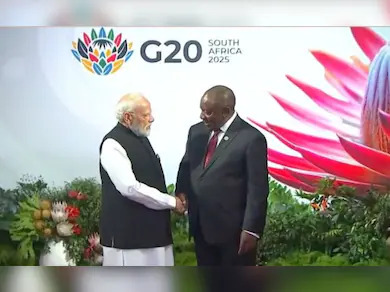
Prime Minister Narendra Modi today proposed India’s civilizational value of Integral Humanism to rethink the parameters of development in the world, with large sections of people being deprived of resources, with Africa a major sufferer – obliquely targeting Europe.
In his address at the G20 session on ‘Inclusive and Sustainable Economic Growth Leaving No One Behind: Building our economies; the role of trade; financing for development and the debt burden’, Modi said the “Historic initiatives taken at the New Delhi G20 Summit have been furthered” at the Johannesburg summit.
Modi added that while the G20 has shaped global finance and global economic growth over the past decades, the parameters of growth have left a large population deprived of resources.
“They have encouraged the over-exploitation of nature. Africa is a major sufferer of this,”, he said targeting the West, notably European nations, for overexploiting the precious natural resources of Africa, and leaving the countries there steeped in poverty in return.
“Today, as Africa hosts the G20 Summit for the first time, we must rethink the parameters of development. One path lies in India’s civilizational values. That path is Integral Humanism.
Earlier G20 Summit adopted the Declaration with an overwhelming majority, despite US boycott, sending an important signal to the world that multilateralism can and does deliver.
The announcement was made by South African President Cyril Ramaphosa at the Summit which began early on Saturday with a war of words between Ramaphosa and US over President Donald Trump’s boycott of the Summit.
The adoption of the Declaration sends an important signal to the world that multilateralism can and does deliver,’’ it was posted on the X handle of the Summit.
The Declaration highlights, in particular, the four of the gravest conflicts in the world including Ukraine and Palestine.
This was Prime Minister’s 12th participation in G20 Summits. Prime Minister addressed both the sessions of the opening day of the Summit.
He thanked President Ramaphosa for his warm hospitality and for successfully
Elaborating India’s approach to growth, development and well-being for all, Prime Minister proposed six ideas for the G20 to consider.
They are: * Creation of a G20 Global Traditional Knowledge Repository: This would harness collective wisdom of humanity for the benefit of future generations.
* Creation of a G20 Africa Skills Multiplier: This program would aim to create a pool of one million certified trainers for skilling the youth in Africa. This would create local capacities and foster long-term development in the continent
* Creation of a G20 Global Healthcare Response Team: This would comprise healthcare experts from each of the G20 countries and could be deployed to deal with global health challenges in any part of the world.
* Establish a G20 Open Satellite Data Partnership: Through this program satellite data of G-20 Space agencies would be made available to developing countries for agriculture, fisheries, disaster management, among other activities.
* Creation of a G20 Critical Minerals Circularity Initiative: This initiative would foster recycling, urban mining, second-life battery projects and innovation of various types, and help in strengthening supply chain security, and develop cleaner pathways of development.
* Creation of a G20 Initiative on Countering the Drug Terror Nexus: This would address drug trafficking and break the drug-terror economy.
Prime Minister also addressed a session on “A Resilient World- G20 Contribution to Disaster Risk Reduction; Climate Change; Just Energy Transition; Food Systems”.
He appreciated that the Disaster Risk Reduction Working Group initiated by India is being taken forward.
He noted that the approach to disaster resilience should be “development-centric”, rather than “response-centric” as exemplified in the Coalition for Disaster Resilient Infrastructure set up by India.
Modi called for greater collective action on climate agenda to strengthen food security.
In this context, he noted the value of millets in promoting nutritional security and environmental sustainability.
Highlighting the Deccan Principles on Food Security adopted during India’s presidency, he noted that such an approach should become the basis for creating a G20 roadmap on food security.
He also called upon developed countries to meet their climate action commitments on providing affordable finance and technology to developing countries in a time bound manner.
Prime Minister sought greater voice for the Global South in global governance structures.
In the context, he noted that the inclusion of the African Union as a permanent member of G20 in New Delhi Summit was a major step forward and this inclusive spirit must also be taken beyond G20.
Comments are closed for this post.