


NewsGate Press Network
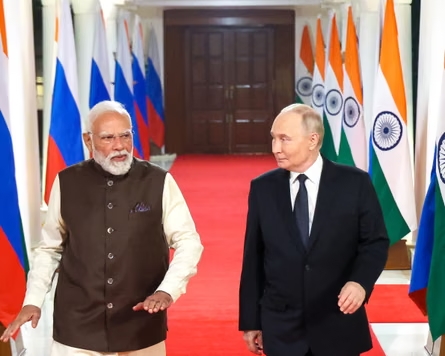
In a landmark visit by the Russian President Vladmir Putin to India, Prime Minister Narendra Modi expressed confidence that trage between the two countries will touch the magical figure of $100B by the year 2030.
Putin who arrived in Delhi late on Thursday the 4th of December 2025 was in the National Capital till Friday late evening held his annual summit meeting with the Indian Prime Minister.
A series of 16 MOUs (Memorandum of Understanding) and Agreements were signed between the two countries on – on grant of 30 days of e-tourist visa to Russian nationals on reciprocal basis; framework for the movement of skilled workers from India to Russia and on cooperation between India and Russia in the field of healthcare, medical education besides agreements on other subjects.
Speaking at the India-Russia Business Forum Modi said – “The greatest strength of India-Russia relations is this trust. It is this trust that gives direction to our joint efforts and also provides momentum,” the Prime Minister said, adding that this is the launchpad that gives inspiration to take flight towards new dreams and aspirations.
Both the leaders in their statements added that India and Russia are committed to combat the scourge of terrorism,
Putin condemned the terror attacks in Jammu and Kashmir’s Pahalgam and Moscow’s Crocus City Hall and strongly pitched for a “zero tolerance” policy on terrorism.
A joint statement released following the summit said Modi and Putin unequivocally condemned all acts of terrorism as unjustifiable, regardless of their motivation.
“They also called for concerted actions against all UN-listed terrorist groups and entities, including Al Qaeda, ISIS/Daesh and their affiliates, aimed at rooting out terrorists’ safe havens, countering the spread of terrorist ideology, eliminating terrorist financing channels and their nexus with transnational crime, and halting cross-border movement of terrorists,” it said.
It said the sides called for an “uncompromising fight” against international terrorism and extremism in all their forms and manifestations, noting the importance of increasing cooperation in this area without hidden agendas and double standards on the solid basis of international law and the UN Charter.
“Besides, they stressed the need for firm implementation of relevant resolutions of the UN Security Council, the UN General Assembly, as well as the balanced implementation of the UN Global Counter-Terrorism Strategy,” it said.
India and Russia also emphasised the primary responsibility of states and their competent authorities in combating terrorism.
“They called for a zero-tolerance policy on terrorism and expeditious finalization and adoption of the Comprehensive Convention on International Terrorism in the UN framework, as well as implementation of the UN General Assembly and the UN Security Council resolutions on countering terrorism and violent extremism conducive to terrorism,” the joint statement said.
The two sides also recalled the special meeting of the UN Security Council’s Counter Terrorism Committee held in India in October 2022 and referred to the unanimously adopted Delhi Declaration on countering the use of new and emerging technologies for terrorist purposes.
India and Russia noted that the declaration aimed to cover the main concerns surrounding the terrorist exploitation of information and communications technology, such as payment technologies, social media platforms and fundraising methods and misuse of unmanned aerial vehicles (UAVs or drones).
“Both sides also expressed their readiness to develop further cooperation in this field with a special focus on preventing radicalisation and the spread of extremist ideology in the online space,” the statement said.
A joint statement released following the summit said Modi and Putin unequivocally condemned all acts of terrorism as unjustifiable, regardless of their motivation.
“They also called for concerted actions against all UN-listed terrorist groups and entities, including Al Qaeda, ISIS/Daesh and their affiliates, aimed at rooting out terrorists’ safe havens, countering the spread of terrorist ideology, eliminating terrorist financing channels and their nexus with transnational crime, and halting cross-border movement of terrorists,” it said.
It said the sides called for an “uncompromising fight” against international terrorism and extremism in all their forms and manifestations, noting the importance of increasing cooperation in this area without hidden agendas and double standards on the solid basis of international law and the UN Charter.
“Besides, they stressed the need for firm implementation of relevant resolutions of the UN Security Council, the UN General Assembly, as well as the balanced implementation of the UN Global Counter-Terrorism Strategy,” it said.
India and Russia also emphasised the primary responsibility of states and their competent authorities in combating terrorism.
“They called for a zero-tolerance policy on terrorism and expeditious finalization and adoption of the Comprehensive Convention on International Terrorism in the UN framework, as well as implementation of the UN General Assembly and the UN Security Council resolutions on countering terrorism and violent extremism conducive to terrorism,” the joint statement said.
The two sides also recalled the special meeting of the UN Security Council’s Counter Terrorism Committee held in India in October 2022 and referred to the unanimously adopted Delhi Declaration on countering the use of new and emerging technologies for terrorist purposes.
India and Russia noted that the declaration aimed to cover the main concerns surrounding the terrorist exploitation of information and communications technology, such as payment technologies, social media platforms and fundraising methods and misuse of unmanned aerial vehicles (UAVs or drones).
“Both sides also expressed their readiness to develop further cooperation in this field with a special focus on preventing radicalisation and the spread of extremist ideology in the online space,” the statement said.
Comments are closed for this post.