


NewsGate Press Network
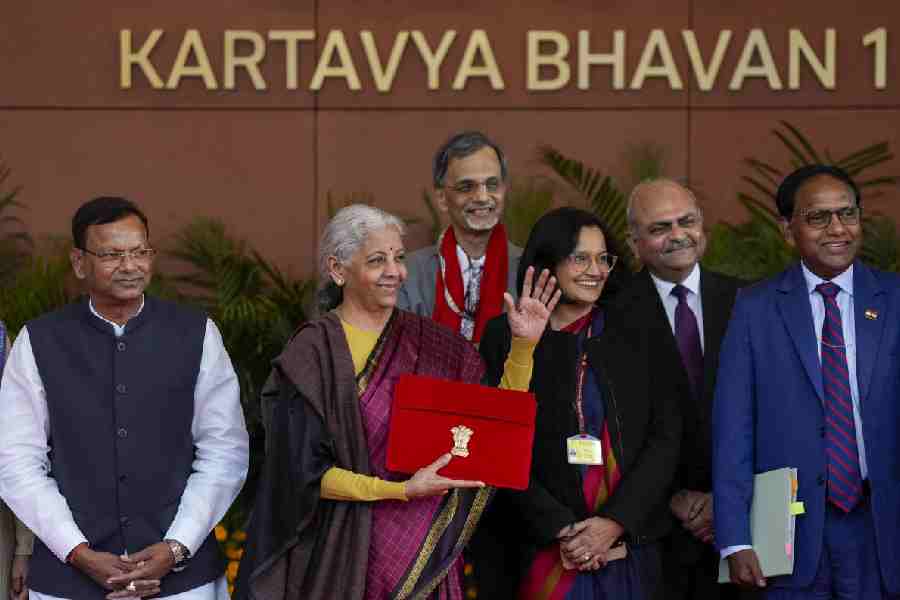
Modi’s “reform express” was formally launched by the Finance Minister Nirmala Sitaraman in Lok Sabha on Sunday the First of February 2026 when she presented this year’s annual budget giving push to slew of initiatives across the broad spectrum.
Her speech was focused on how make India a global manufacturing hub in high-value and strategically sensitive sectors, while strengthening supply chains and supporting long-term economic growth.
Following are the highlights of Annual Budget 2026-27:
- The non-debt receipts and the total expenditure are estimated as ₹36.5 lakh crore and ₹53.5 lakh crore respectively. The Centre’s net tax receipts are estimated at ₹28.7 lakh crore.
- The gross market borrowings are estimated at ₹17.2 lakh crore and the net market borrowings from dated securities are estimated at ₹11.7 lakh crore.
- The Revised Estimates of the non-debt receipts are ₹34 lakh crore of which the Centre’s net tax receipts are ₹26.7 lakh crore.
- The Revised Estimate of the total expenditure is ₹49.6 lakh crore, of which the capital expenditure is about ₹11 lakh crore.
- The fiscal deficit in BE 2026-27 is estimated to be 4.3 percent of GDP.
- In RE 2025-26, the fiscal deficit has been estimated at par with BE of 2025-26 at 4.4 percent of GDP.
- The debt-to-GDP ratio is estimated to be 55.6 percent of GDP in BE 2026-27, compared to 56.1 percent of GDP in RE 2025-26.
- An allocation of ₹5000 crore over 5 years, per city economic regions (CER) announced, for implementing their plans through a challenge mode with a reform-cum-results based financing mechanism.
- Government to develop Seven High-Speed Rail corridors between cities as ‘growth connectors’ to promote environmentally sustainable passenger systems. These include:
- Mumbai-Pune
- Pune-Hyderabad,
- Hyderabad-Bengaluru,
- Hyderabad-Chennai
- Chennai-Bengaluru,
- Delhi-Varanasi,
- Varanasi-Siliguri.
- Government to setup a “High Level Committee on Banking for Viksit Bharat”, to comprehensively review the sector and align it with India’s next phase of growth, while safeguarding financial stability, inclusion and consumer protection.
- Government to restructure the Power Finance Corporation and Rural Electrification Corporation to achieve scale and improve efficiency in the Public Sector NBFCs.
- A comprehensive review of the Foreign Exchange Management (Non-debt Instruments) Rules is proposed, to create a more contemporary, user-friendly framework for foreign investments, consistent with India’s evolving economic priorities.
- An allocation of ₹5000 crore over 5 years, per city economic regions (CER) announced, for implementing their plans through a challenge mode with a reform-cum-results based financing mechanism.
- Government to develop Seven High-Speed Rail corridors between cities as ‘growth connectors’ to promote environmentally sustainable passenger systems. These include:
- Mumbai-Pune
- Pune-Hyderabad,
- Hyderabad-Bengaluru,
- Hyderabad-Chennai
- Chennai-Bengaluru,
- Delhi-Varanasi,
- Varanasi-Siliguri.
- Government to setup a “High Level Committee on Banking for Viksit Bharat”, to comprehensively review the sector and align it with India’s next phase of growth, while safeguarding financial stability, inclusion and consumer protection.
- Government to restructure the Power Finance Corporation and Rural Electrification Corporation to achieve scale and improve efficiency in the Public Sector NBFCs.
- A comprehensive review of the Foreign Exchange Management (Non-debt Instruments) Rules is proposed, to create a more contemporary, user-friendly framework for foreign investments, consistent with India’s evolving economic priorities.
- Scaling up manufacturing in 7 strategic and frontier sectors
- Biopharma SHAKTI (Strategy for Healthcare Advancement through Knowledge, Technology and Innovation) announced, with an outlay of ₹ 10,000 crores over the next 5 years to develop India as a global Biopharma manufacturing hub.
- A Biopharma-focused network to be created with 3 new National Institutes of Pharmaceutical Education and Research (NIPER) and upgrading 7 existing ones.
- A network of over 1000 accredited India Clinical Trials sites to be created
- India Semiconductor Mission (ISM) 2.0 to be launched to produce equipment and materials, design full-stack Indian IP, and fortify supply chains with focus on industry led research and training centres to develop technology and skilled workforce.
- The Electronics Components Manufacturing Scheme outlay increased to ₹40,000 crore.
- Dedicated Rare Earth Corridors to be established, to support the mineral-rich States of Odisha, Kerala, Andhra Pradesh and Tamil Nadu to promote mining, processing, research and manufacturing.
- Government to launch a Scheme to support States in establishing 3 dedicated Chemical Parks, through challenge route, on a cluster-based plug-and-play model.
- Strengthening Capital Goods Capability
- Hi-Tech Tool Rooms to be established by CPSEs at 2 locations as digitally enabled automated service bureaus that locally design, test, and manufacture high-precision components at scale and at lower cost.
- A Scheme for Enhancement of Construction and Infrastructure Equipment (CIE) to be introduced, to strengthen domestic manufacturing of high-value and technologically-advanced CIE.
- New Dedicated Freight Corridors to be established connecting Dankuni in the East, to Surat in the West
- 20 new National Waterways (NW) to be operationalised over next 5 years, starting with NW-5 in Odisha to connect mineral rich areas of Talcher and Angul and industrial centres like Kalinga Nagar to the Ports of Paradeep and Dhamra.
Training Institutes to be set up as Regional Centres of Excellence for development of the required manpower. - Further, a ship repair ecosystem catering to inland waterways to be set up at Varanasi and Patna
- 20 new National Waterways (NW) to be operationalised over next 5 years, starting with NW-5 in Odisha to connect mineral rich areas of Talcher and Angul and industrial centres like Kalinga Nagar to the Ports of Paradeep and Dhamra.
- A Coastal Cargo Promotion Scheme to be launched for incentivising a modal shift from rail and road, to increase the share of inland waterways and coastal shipping from 6% to 12 % by 2047.
- Incentives to be provided to indigenize manufacturing of seaplanes and enhance last-mile and remote connectivity, and promote tourism.
Seaplane VGF Scheme to be introduced to provide support for operations.
Comments are closed for this post.