


NewsGate Press Network
Every year 4th of December is celebrated as the Indian Navy Day to commemorate the deadly strike on Port of Karachi during the 1971 war with Pakistan.
This year the celebration will be held at at Shangumugham Beach in Thiruvananthapuram, Kerala.
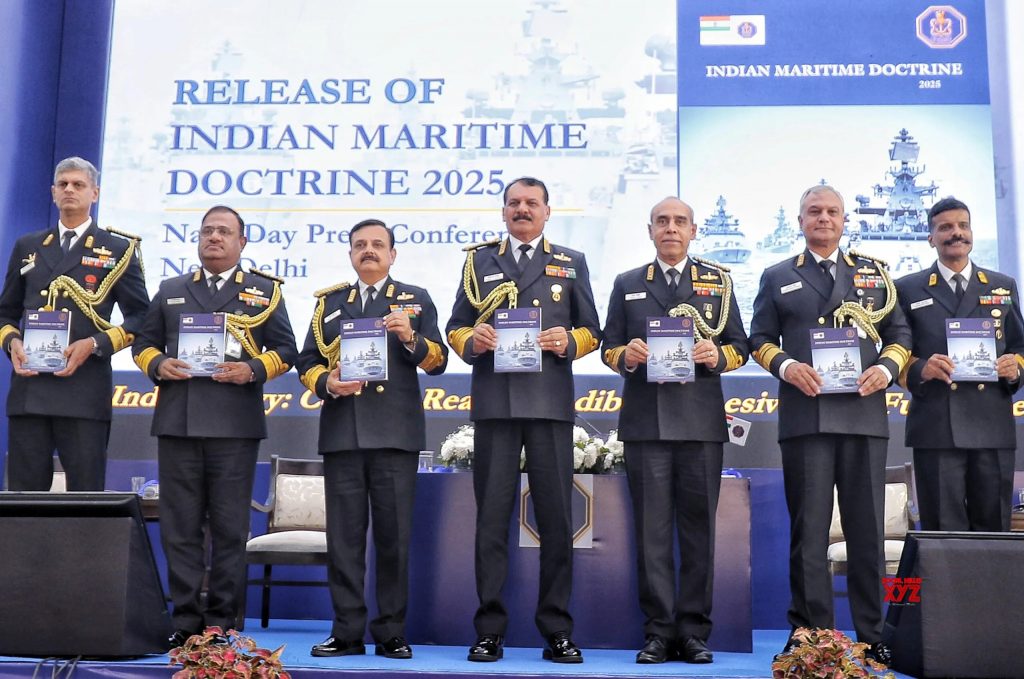
In his annual Navy Day presser, the Chief of Naval Staff Admiral Dinesh K Tripathi released the new edition of Indian Maritime Doctrine 2025.
Significance of the Naval Doctrine. The Indian Maritime Doctrine is the apex guidance document of the Indian Navy.
Initially published in 2004 and revised in 2009, with minor amendments in 2015, the 2025 edition reflects the major transformations in India’s maritime environment and strategic outlook.
The Indian Maritime Doctrine 2025 lays the foundation for the Navy’s strategy and operations, providing a shared understanding of the principles that guide employment across the spectrum of conflict.
It clearly defines the Navy’s roles, answering the central question: “Why we do what we do.”
India’s Strategic Context. This new edition reflects the transformation in India’s maritime environment over the last decade and incorporates India’s broader vision of harnessing the oceans as a key pillar of Viksit Bharat 2047.
This outlook is reinforced through major Government of India initiatives, such as Sagarmala, PM Gati Shakti, Maritime India ision 2030, Maritime Amrit Kaal Vision 2047, and MAHASAGAR.
It also recognises the growing maritime security challenges characterised by multi-domain threats, a diverse set of actors, and rapid advancements in technology.
Key Highlights of the Indian Maritime Doctrine 2025.
This edition formalises No-War No-Peace as a distinct category between peace and conflict, establishing it as an important facet of the conflict spectrum.
It integrates an enhanced understanding of tactics employed by adversaries, including grey-zone, hybrid, and irregular warfare.
The revised doctrine also acknowledges the growing importance of the space, cyber, and cognitive domains, while emphasising on the integration of uncrewed systems, autonomous platforms, and emerging technologies.
Additionally, it prioritises joint man-ship by aligning with tri-service joint doctrines, towards ensuring interoperability across the Armed Forces.
Apart from releasing the details of the revised edition of Maritime Doctrine Admiral Tripathi told the reporters that Navy’s third indigenous nuclear ballistic missile submarine INS Aridhaman has now entered its final stages of trials.
This particular war machine belongs to the trio of Arihant-class nuclear ballistic submarines, the platform features an expanded missile payload, enabling it to carry more long-range nuclear missiles than the INS Arighaat, which was commissioned in August 2024.
Speaking about the enhanced capability of INS Vikrant, CNS Tripathi said Navy’s first four Rafale aircraft are scheduled to be inducted in 2029.
The French will be supplying 26 Rafales for aircraft carrier INS Vikrant.
of these aircraft carrier-ready jets was finalised with France in April, and deliveries are set to commence in five years from the signing. The package includes armaments, spares and supporting equipment, and the fighters will be stationed aboard INS Vikrant.
Comments are closed for this post.