


DefenceTimes Press Network
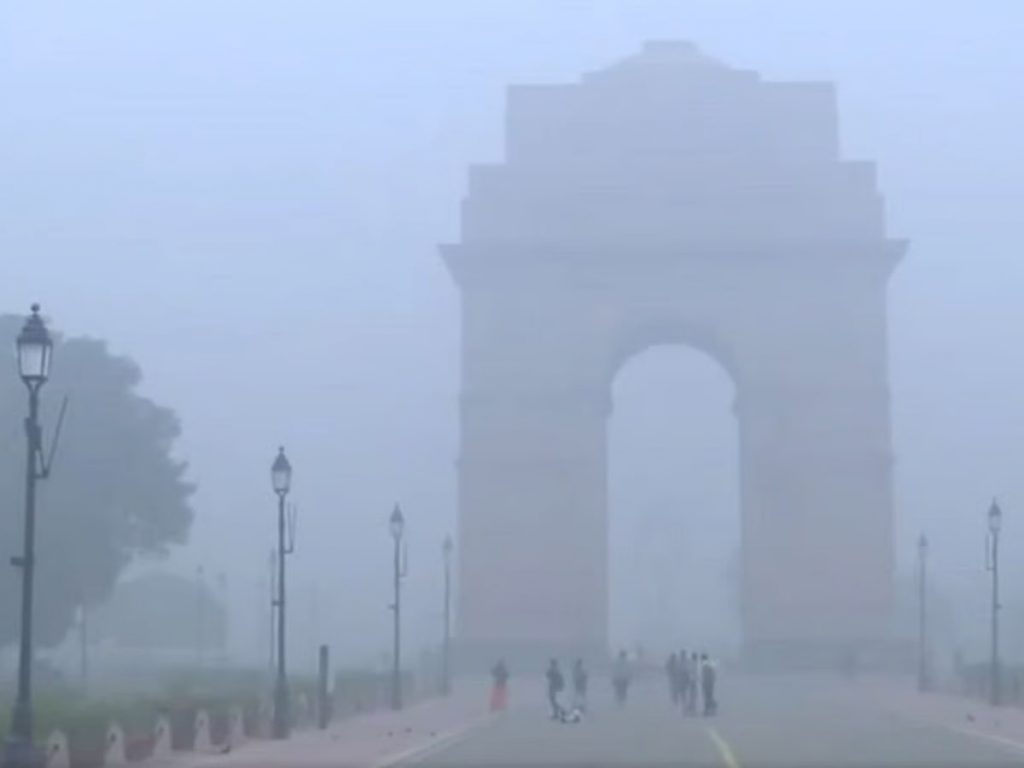
Delhi again woke-up to a toxic morning on Sunday the 23rd of November 2025 as the AQI index crossed over 450 mark in at least two monitoring locations.
It has been the 10th straight day since the National Capital had recorded a ‘very poor’ category in the air quality index.
A layer of thick smog engulfed several areas, showing little to no improvement from Sunday morning’s AQI of 359.
The city’s 24-hour average Air Quality Index (AQI) rose to 391 at 4 p.m., according to data from the Central Pollution Control Board (CPCB).
Pollution monitoring station located at Bawana recorded the highest AQI level of 435 at 7 am, falling under the ‘severe’ category.
In contrast, NSIT Dwarka recorded the lowest AQI of 313, according to the data by the Central Pollution Control Board (CPCB).
A layer of toxic smog lingers in the air of Anand Vihar, as the Central Pollution Control Board reported that the Air Quality Index in the area is 429, categorised as ‘very poor’.
Chandani Chowk recorded an AQI of 390, RK Puram 397, ITO 384, Punjabi Bagh 411, Patparganj 401, Pusa 360, and Dwaraka Sector-8 386.
Visuals from India Gate and Kartavya Path are blanketed in a layer of toxic smog, with the AQI in the area at 388 in the ‘very poor’ category, according to the CPCB.
According to AQI categorisation, 0-50 is ‘good’, 51-100 ‘satisfactory’, 101-200 ‘moderate’, 201-300 ‘poor’, 301-400 ‘very poor’, and 401-500 ‘severe’.
It may be recalled that on Saturday the 22nd of November 2025, the Commission for Air Quality Management (CAQM) NCR and Adjoining – has revised the Graded Response Action Plan (GRAP) for the entire NCR, directed to impose the measures for ‘Severe’ AQI category under GRAP Stage IV to be taken under GRAP Stage III, a press release said.
According to a press statement by CAQM, as measures under GRAP IV are now under GRAP III, the NCR State Governments/GNCTD will decide whether public, municipal, and private offices can operate at 50 per cent strength, with the rest working from home.
The Central Government may take a decision on permitting work from home for employees in central government offices.
Earlier on Friday, Aam Aadmi Party (AAP) Delhi State President Saurabh Bharadwaj alleged that Delhi’s pollution crisis has become a public health emergency due to the manipulation of air quality data and the failure to enforce graded restrictions meant to curb toxic air.
Bharadwaj accused the BJP-run Delhi Government of fabricating AQI readings and allowing both government and private construction to operate despite GRAP-3 bans. He said pollution levels of 500-700 were falsely recorded as 300-400 to avoid triggering mandatory restrictions.’
Comments are closed for this post.